
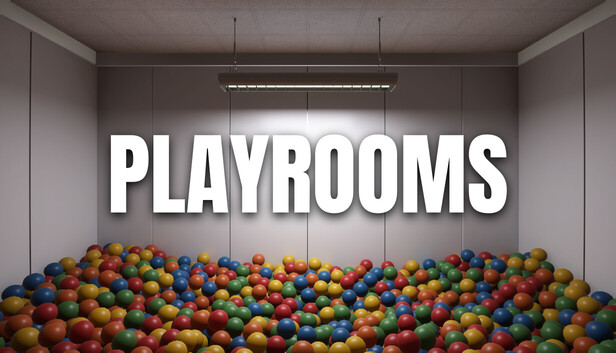
There are some games that sound completely ridiculous on paper, yet somehow manage to turn the simplest ideas into something genuinely entertaining. Playrooms is one of those games.
Developed and published by Two Pixels UG, Playrooms takes the seemingly mundane task of collecting plastic balls scattered throughout an abandoned indoor play area and transforms it into a strangely addictive cleaning simulator with a psychological horror twist.
With over 200,000 balls waiting to be collected, the job is certainly not a small one. Throw in eerie corridors, unsettling environments and the constant threat of something lurking in the darkness, and suddenly cleaning up after a children’s play session doesn’t sound quite so relaxing.
It’s an unusual combination of genres, but one that gives Playrooms a distinctive identity in an increasingly crowded indie gaming market.
The Most Unusual Cleaning Job You’ll Ever Have
The premise of Playrooms couldn’t be much simpler. You’re alone in a mysterious facility filled with colourful plastic balls, and your responsibility is to collect them and return them to their respective ball pits.
Why are there so many balls scattered around? Why does this facility appear abandoned? And, perhaps most importantly, why are you still working here?
Those questions establish an intriguing backdrop, but the main attraction is the cleaning itself.
Collecting balls, returning them to their designated locations and watching previously chaotic environments gradually become organised creates an immediately understandable sense of progression.
It’s the same satisfying formula that makes games about cleaning, sorting and restoring environments so appealing. The tasks themselves aren’t particularly complicated, but watching the results of that work unfold provides a surprisingly strong incentive to continue.
What makes Playrooms particularly interesting is how it incorporates incremental progression into this basic concept.
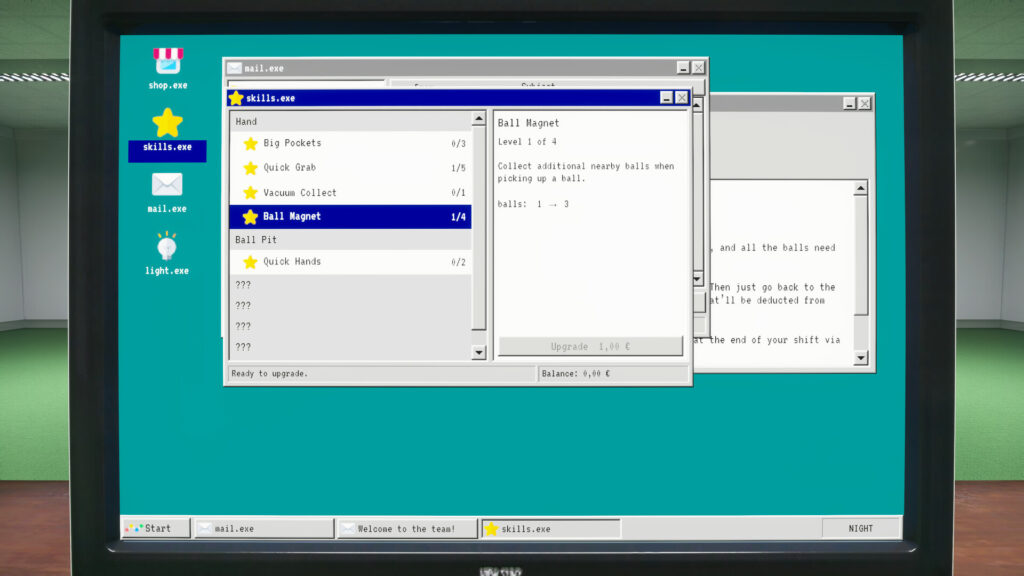
The balls you collect effectively become your currency, allowing you to purchase better equipment and improve your ability to tackle larger areas. Filling ball pits also unlocks new abilities, while progression eventually opens the way into additional rooms.
There’s a clear emphasis on efficiency, turning what begins as a relatively slow collection process into an opportunity to invest in increasingly useful tools.
It’s a clever approach to an otherwise basic gameplay loop, giving the player something to work towards beyond simply clearing another floor.
A Satisfying Progression System
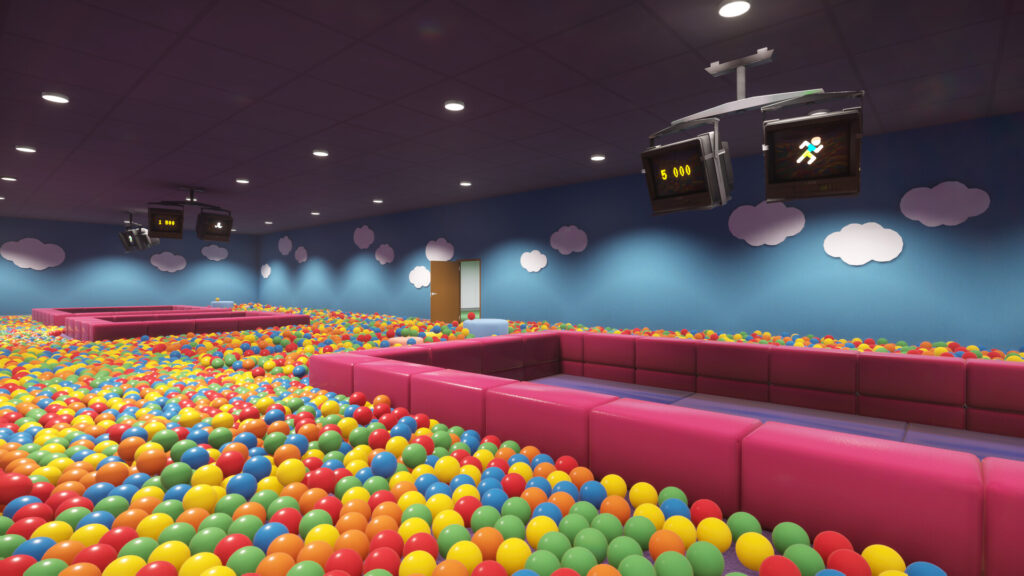
A game built around picking up thousands of objects needs a strong sense of progression to remain interesting, and the equipment system is arguably one of Playrooms’ most important features.
Starting with relatively straightforward collection methods, players can work towards purchasing tools such as scoops and other equipment designed to make the clean-up process easier.
The ability to improve efficiency is central to the game’s appeal.
Rather than introducing completely different objectives every few minutes, Playrooms encourages players to become better at performing the same task.
It’s an uncomplicated formula, but an effective one for anyone who enjoys incremental games where every upgrade makes a noticeable difference to how tasks are approached.
There’s also something inherently satisfying about transforming a cluttered environment into a cleaner, more organised space.
However, this is also where the game’s biggest limitation becomes apparent.
No matter how many upgrades are introduced, the fundamental activity remains largely unchanged. Collecting balls might become faster and more efficient, but the underlying objective is still collecting balls.
For players who enjoy repetitive, progression-driven gameplay, that’s unlikely to be a significant issue. Others may eventually find themselves wishing for more variety.
It’s a balancing act that Playrooms doesn’t entirely escape, even if the unusual setting helps keep things interesting.
There’s Something Wrong with These Playrooms
While cleaning provides the foundation, the atmosphere is what gives Playrooms its personality.
Inspired by the unsettling aesthetic of the Backrooms, the game places its otherwise ordinary activities inside environments that feel distinctly unnatural.
Brightly coloured play areas sit alongside empty corridors, unusual layouts and spaces that appear familiar but somehow wrong.
It’s an effective setting for psychological horror because the environments don’t need to look conventionally frightening.
In fact, the contrast between the cheerful colours of a children’s play area and the eerie emptiness surrounding it is precisely what makes the atmosphere so uncomfortable.
There’s an unsettling quality to the idea of being completely alone in a place that should ordinarily be full of noise, activity and people.
The environmental design plays an important role in establishing that atmosphere, making Playrooms feel noticeably different from a conventional cleaning simulator.
Rather than relying entirely on monsters or constant jumpscares, the game incorporates the uncertainty of its surroundings into the experience.
That approach works particularly well with the slow, methodical nature of the cleaning mechanics. The ordinary task gives the player a reason to remain in places that would otherwise seem best avoided.
When the Lights Go Out, Everything Changes
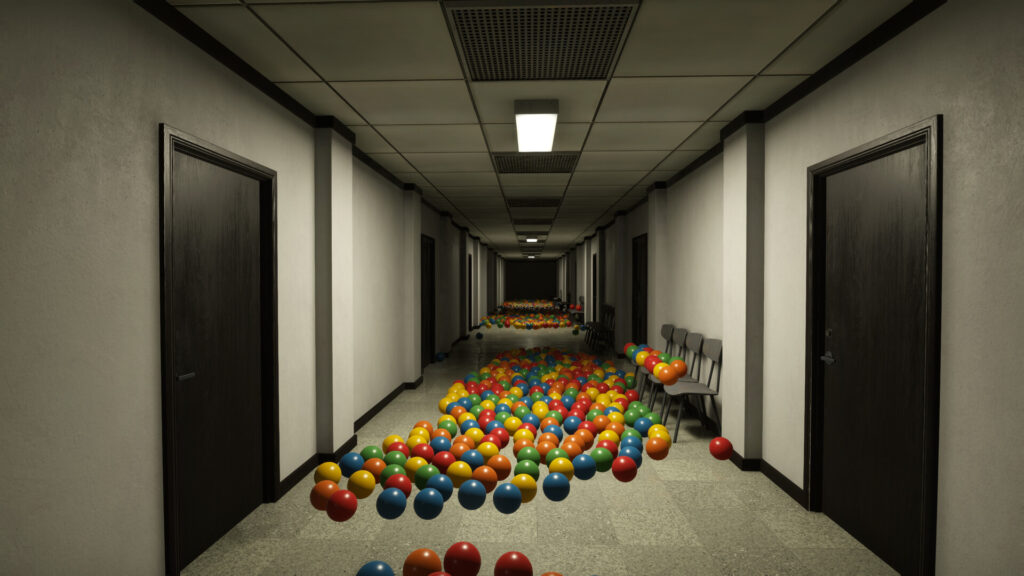
The horror mechanics become particularly important when the facility’s working hours come to an end.
As the shift finishes, lights begin switching off around the environment, creating an entirely different challenge from the otherwise straightforward cleaning routine.
Staying within illuminated areas becomes essential, with darkness presenting a threat that players are encouraged to avoid.
It’s a simple but effective idea.
During normal working conditions, the focus is on collection, organisation and progression. Once the lights begin disappearing, those priorities change considerably.
The mechanic gives the game an additional layer of tension without abandoning its underlying identity.
There’s also something amusingly sinister about the idea that an ordinary cleaning shift could suddenly become a fight to remain somewhere safe.
Playrooms isn’t attempting to compete with large-scale survival horror games through elaborate combat or complicated enemy systems. Instead, it uses vulnerability and uncertainty to make a relatively harmless environment feel threatening.
The drawback is that this approach depends on maintaining the element of surprise.
Once the dangers become more familiar, the horror risks losing some of its effectiveness. Repeated scares can only remain surprising for so long, particularly in a game where players are encouraged to revisit similar activities.
Nevertheless, the combination of cleaning and psychological horror remains an interesting concept that helps distinguish Playrooms from other games drawing inspiration from the Backrooms.
Horror or Relaxation? The Choice Is Yours
One of the smartest decisions behind Playrooms is that its horror elements aren’t mandatory.
Players can choose how dangerous they want their experience to be, including an option that removes the frightening elements altogether.
This flexibility significantly broadens the game’s appeal.
Not everyone interested in a satisfying cleaning simulator necessarily wants to spend their time worrying about what might be hiding down the next corridor.
Likewise, players looking for a more intense experience can embrace the additional danger.
By allowing the horror to be adjusted, Playrooms avoids forcing its two very different genres onto everyone in exactly the same way.
It’s a particularly welcome feature in a game where the relaxing nature of the cleaning mechanics is such a major part of the attraction.
The ability to enjoy the progression system without the threat of horror encounters also gives the experience a degree of replayability.
It’s an example of a relatively small design decision making a meaningful difference to the game’s accessibility.
Does the Gameplay Have Enough Variety?
As entertaining as the concept is, Playrooms isn’t without its shortcomings.
The biggest concern is the repetitive nature of its core gameplay.
The satisfaction of collecting balls, unlocking upgrades and clearing environments provides a strong foundation, but there’s only so much variety that can be achieved when the primary objective remains the same throughout.
Additional locations help provide visual changes, while new equipment gives players a reason to continue progressing. However, neither completely changes the fundamental structure.
This is unlikely to bother players who specifically enjoy incremental simulators, where repetition and gradual improvement are part of the appeal.
For anyone expecting a more traditional horror adventure with a wide range of objectives, though, Playrooms might feel somewhat limited.
The horror elements also face a similar challenge.
Atmosphere and uncertainty can be extremely effective, but familiarity naturally reduces their impact over time.
The concept is arguably stronger than the variety of activities supporting it, although that doesn’t stop the experience from having a clear appeal to its intended audience.
A Distinctive Addition to the Indie Horror Scene
Independent developers often produce some of gaming’s most creative ideas, and Playrooms is an excellent example of how combining familiar mechanics can create something unusual.
Cleaning simulators are nothing new, nor are Backrooms-inspired horror games. Bringing them together, however, produces a concept that feels considerably more distinctive.
The game’s strengths are found in its straightforward objectives, incremental upgrades and unsettling presentation.
It doesn’t need an elaborate collection of mechanics to communicate what makes it interesting.
Instead, it relies on the satisfaction of completing an ordinary task while introducing the possibility that something far less ordinary might happen along the way.
There’s a clear audience for this combination, particularly among players who enjoy games built around organisation, collection and steady progression.
And with the ability to disable horror encounters entirely, Playrooms has the potential to appeal to people who wouldn’t ordinarily consider playing something associated with psychological horror.
It may not be the most mechanically ambitious indie release, but it certainly offers an unusual proposition.
PlayLattice Verdict
7.5/10 – Good
Playrooms is a wonderfully unusual combination of satisfying cleaning mechanics and unsettling psychological horror.
Its simple gameplay loop is strengthened by an engaging upgrade system, while the eerie Backrooms-inspired environments give the experience an identity beyond that of an ordinary cleaning simulator.
The ability to adjust or completely remove the horror elements is an especially welcome feature, making the game accessible to a wider audience without abandoning its original concept.
However, the repetitive nature of collecting thousands of plastic balls remains its greatest weakness. Even with additional equipment and changing environments, the fundamental gameplay doesn’t offer a huge amount of variety.
Despite these limitations, Playrooms stands out as a creative indie experience with a surprisingly appealing premise.
For fans of incremental simulators, relaxing organisation games and unusual psychological horror, there’s plenty here worth exploring.
Sometimes, even the simplest job can become a nightmare.
Playrooms is available now on Steam for PC, with a free demo available for anyone wanting to experience the concept before purchasing.

Discussion 0
Share your thoughts about this story. Keep it respectful and on topic.
No comments yet. Be the first to join the discussion.